Class Personification Exercise:
a. The trees swayed/embraced/danced/whispered in the moonlight.
b. The clouds glowered menacingly in the rainstorm.
c. The latch bit his finger with metal teeth.
d. The house stared down at her with empty glass eyes.
More examples:
a. The driver started the engine with some difficulty.
--> The car engine coughed and sputtered when it started during the blizzard.
b. The driver drove the car quickly down the hill.
--> The car roared to life and raced down the hill.
c. The tourists walked past a field of beautiful yellow daffodils.
--> The daffodils nodded their yellow heads at the tourists.
d. The wind blew and the leaves fell.
--> The wing sang her mournful song through the falling leaves.
Monday, April 9, 2007
Personification
A figure of speech in which human qualities are given to non-human things, such as animals, nature, ideas or inanimate objects.
NON-HUMAN ---> HUMAN
Ways to make something human:
1. Make it move like a person: eg. run, cartwheel, reach, embrace
2. Make it sound like a person: eg. shout, whisper, laugh, listen
3. Give it emotion: eg. joy, hope, sadness, despair
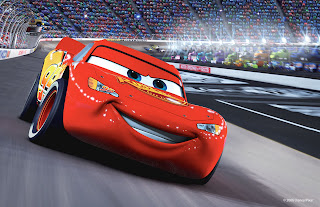
* To view Pixar's Animation on "Cars," please click here.
NON-HUMAN ---> HUMAN
Ways to make something human:
1. Make it move like a person: eg. run, cartwheel, reach, embrace
2. Make it sound like a person: eg. shout, whisper, laugh, listen
3. Give it emotion: eg. joy, hope, sadness, despair
* To view Pixar's Animation on "Cars," please click here.
How would you personify the car?
1.The car peered over the cliff and gazed in awe at the splendour of the landscape.
2.The car mustered all its strength and raced towards the finishing line, gloating all the way.

Literal vs Figurative Language
What is the difference between Literal & Figurative Language?
Literal Language....
is direct & straightforward.
It conveys facts.
Examples: Dictionary Definitions, Instructions
Figurative Language....
is creative & imaginative.
It conveys personal ideas or opinions.
Examples: Metaphors, Similes, Personification
Can you spot the difference?
1. He is very strong --> He is as strong as an ox. (simile)
2. He eats very messily --> He eats like a pig. (simile)
3. She is very improtant to me --> She is the sunshine of my life. (metaphor)
4. The driver drove the car quickly down the hill --> The car roared to life and raced down the hill. (personification)
Literal Language....
is direct & straightforward.
It conveys facts.
Examples: Dictionary Definitions, Instructions
Figurative Language....
is creative & imaginative.
It conveys personal ideas or opinions.
Examples: Metaphors, Similes, Personification
Can you spot the difference?
1. He is very strong --> He is as strong as an ox. (simile)
2. He eats very messily --> He eats like a pig. (simile)
3. She is very improtant to me --> She is the sunshine of my life. (metaphor)
4. The driver drove the car quickly down the hill --> The car roared to life and raced down the hill. (personification)
Monday, April 2, 2007

Superman (It’s not Easy)
By Five for Fighting
I can’t stand to fly
I’m not that naive
I’m just out to find
The better part of me
I’m more than a bird... I’m more than a plane
More than some pretty face beside a train
It’s not easy to be me
Wish that I could cry
Fall upon my knees
Find a way to lie
About a home I’ll never see
It may sound absurd... but don’t be naive
Even heroes have the right to bleed
I may be disturbed... but won’t you concede
Even heroes have the right to dream
It’s not easy to be me
Up, up and away... away from me
It’s all right... you can all sleep sound tonight
I’m not crazy... or anything...
I can’t stand to fly
I’m not that naive
Men weren’t meant to ride
With clouds between their knees
I’m only a man in a silly red sheet
Digging for kryptonite on this one way street
Only a man in a funny red sheet
Looking for special things inside of me
I’m only a man
In a funny red sheet
I’m only a man
Looking for a dream
I’m only a man
In a funny red sheet
And it’s not easy…It’s not easy to be me
To watch the music video, please click here.
Wednesday, March 28, 2007
How to Eat a Poem

How to Eat a Poem
By Eva Merriam
Don't be polite.
Bite in.
Pick it up with your fingers and lick the juice that
may run down your chin.
may run down your chin.
It is ready and ripe now, whenever you are.
You do not need a knife or fork or spoon or plate or napkin or tablecloth.
You do not need a knife or fork or spoon or plate or napkin or tablecloth.
For there is no core
or stem
or rind
or pit
or seed
or skin
to throw away.
The poet compares a poem to a fruit to show that a poem is meant to be savoured fully, like a fruit. When she says "bite in," she means it as an invitation to the reader to taste and enjoy the poem. Just as the fruit is rich in juice, the poem is similarly rich in meaning. The poet also tells us in the second stanza that there is nothing to throw away in the poem because every word is precious and nothing ought to be wasted.
By comparing a poem to a fruit, the poet is trying to tell us to look forward to reading poetry and reading it enthusiastically, in the same way we would look forward to sinking our teeth into a juicy fruit.
Poets make use of metaphors in poetry for many reasons. Sometimes poets use metaphors to help us understand something that is hard to describe, and other times they use metaphors to leave a deep impression on our minds. Metaphors enliven ordinary language and make us sit up and take notice of what the poet is trying to say.
By comparing a poem to a fruit, the poet is trying to tell us to look forward to reading poetry and reading it enthusiastically, in the same way we would look forward to sinking our teeth into a juicy fruit.
Poets make use of metaphors in poetry for many reasons. Sometimes poets use metaphors to help us understand something that is hard to describe, and other times they use metaphors to leave a deep impression on our minds. Metaphors enliven ordinary language and make us sit up and take notice of what the poet is trying to say.
Metaphors and Similes
A METAPHOR is a figure of speech that draws comparisons between two unlike things in an arresting or memorable way.
For example:
For example:
- Life is a box of chocolates (Forrest Gump)
- The world's a stage (William Shakespeare)
- You are the sunshine of my life
- Love is a universal migraine
- John swelled and ruffled his plumage (implied metaphor)
- He inspected her with a vulture's eye (implied metaphor)
- The rugby player cradled the giant egg ball (implied metaphor)
A SIMILE a type of metaphor in which two unlike things are compared using "like" or "as."
For example:
- As light as a feather
- As heavy as an ox
- As sly as a fox
- As busy as a bee
- As proud as a peacock
- As clear as a bell
- As pure as snow
- As quick as lightning
- He eats like a pig.
- Her eyes are like the sun.
- She ran like the wind.
- The twins are like two peas in a pod
- Her hair was like gravy, running brown off her head and clumping up on her shoulders.
Friday, March 23, 2007
Dreams
 Dreams
 By Langston Hughes
Hold fast to dreams
For if dreams die
Life is a broken-winged bird
That cannot fly.
Hold fast to dreams
For when dreams go
Life is a barren field
Frozen with snow.
Hughes uses the metaphor of a broken-winged bird to show that if we let go of our dreams, we would be unable to soar and live up to our potential. He also uses the metaphor of the barren field to show that if we let go of our dreams, life would be dead and empty, like a wasteland.
Subscribe to:
Posts (Atom)